
← back to wikibrad
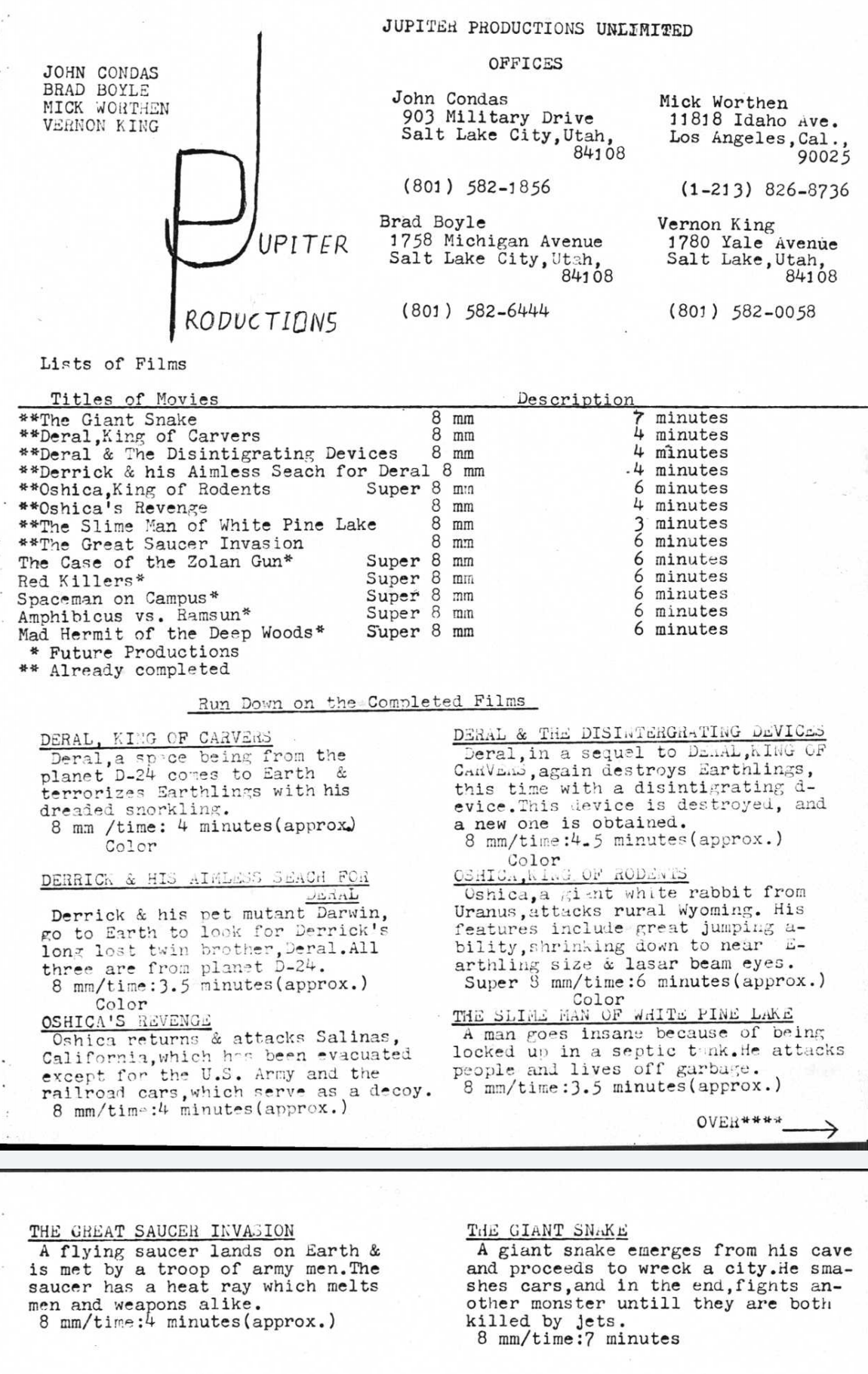
Jupiter Productions began in the summer of 1972, just after grade school. It was almost a rule that monster movie kids back then made their own films. Mick Ellison (later Worthen) was my best friend, and along with John Condas and Vernon King, we formed Jupiter Productions. Mick's family owned a Super 8mm camera, and Mick and I split the cost to purchase a manual 8mm film editor.
I have very grainy copies of later, longer films like Night of the Carnivorous Corpses, but unfortunately the early films have been lost. It is one of my great regrets. Mick was in charge of ownership, and while a couple of later films were saved, he lost all the classics. Mick has departed this plane, so there is little hope of the films being found. Mick never stopped making films and pursued a career in the film industry.
Deral Bishop was our 6th grade teacher and a memorable one. He was the inspiration for the spaceman in King of the Carvers because he whittled his hands with a small knife. He had suffered an industrial accident, and his hands had lots of dead skin. Such behavior caught the attention of 6th graders. I don't think he realized the room would become alert when the message was silently passed: "Deral is carving."
When Deral was mad, he would poke you in the hollow just above the collarbone. We called that snorkeling. He really did have a twin. I had to sit next to Deral all year so he could watch over me—just me and Deral at the back of the room.
Deral, a wandering space being from Planet D-24 (I'm not sure where planet D-24 came from; it's not in any science fiction movie I know of), arrives on Earth and terrorizes it with his dreaded snorkeling, leaving a trail of victims. Mick played Deral and was the natural actor of the group, taking on most of the major roles.
A sequel to Deral, King of the Carvers. Deral returns with a new weapon—a disintegrating device—and again threatens Earth. The device is destroyed, but another is obtained, continuing the cycle. This movie was a foray into special effects. Deral would point his disintegrating device at an object, and a ray would shoot, and the object would disappear. After Mick aimed his weapon, we would stop the film and remove whatever object he was shooting at. Then later, on the manual film editor, Mick would scratch the frames one by one to make the ray come to life. People were easy to make disappear, and we also made cars and even a stop sign disappear. The stop sign was at the corner of 1800 East and Yale Avenue in Salt Lake City and was already loose because someone had hit it. After Mick aimed his ray gun, we picked it up out of the ground. Poof! Stop sign disintegrated by an alien ray. Note: we replaced the stop sign.
Derrick and his mutant companion Darwin travel to Earth searching for Derrick’s long-lost twin brother, Deral. All originate from Planet D-24. Since Derrick was Deral's twin, Mick was again cast in the leading role. John Condas played the mutant companion Darwin. It is open to speculation why he was chosen for the role.
Oshica, a giant white rabbit from Uranus, attacks rural Wyoming. I think we were the first kids to get the Uranus joke. Oshica's abilities include massive jumping power, shrinking in size, and firing laser beams from his eyes. John Condas's rabbit starred as Oshica. Film fans will realize our inspiration was Night of the Lepus, which we had recently seen.
Oshica returns and attacks Salinas, California, which has been evacuated except for the United States Army. Decoy railroad cars were used to attract the gigantic rodent. This plot structure let us use model trains, tracks, and army tanks on some dead grass to simulate Salinas. Rabbit food was carefully hidden in the miniature props, and then Oshica was let loose to cause mayhem and destruction. Why Salinas? I think John picked it. I don't think the rest of us even knew the town, let alone that trains passed through it, and in the summer it was all dry, dead grass.
A man driven insane after being trapped in a septic tank emerges and survives by attacking people and living off garbage. We filmed this at a pond by Mount Olivet Cemetery in Salt Lake City. Mick starred in this one, because no one else would go in the algae-covered pond. That’s where we got the name — he was completely covered when he got out.
A flying saucer lands on Earth and battles the military. Its heat ray melts both soldiers and weapons. To us, Plan 9 From Outer Space wasn't one of the worst movies ever made. It was inspiration for building and filming flying saucers. The most enjoyable part of making this film was taking a blow torch to plastic army men and tanks.
A giant snake emerges from its cave and destroys Salt Lake City, smashing cars before ultimately being destroyed by jets. Our panicked crowd scenes were filmed at the University of Utah's Marriott Library, which back in 1973 was the most modern building we knew. It was a dream to play a panicked bystander, running while glancing backward at the approaching giant monster. This was our foray into stop-motion animation. Maybe not Ray Harryhausen quality, but that was because our inspiration was Mike Cassidy's The Giant Brine Shrimp, another clay-animated monster set in Salt Lake City. The giant snake — which surprises me we never named; I only assume we were copying the title format of The Giant Brine Shrimp — was made of modeling clay pilfered from Mick's sister, who was an art major at the U of U. After a few days of animating the snake, we had enough and had toy jets crash into it and catch fire to conclude the film. I think the actual animation only lasted thirty seconds or so. Probably less.
The “lost” 1975 zombie film made by Hot Damn Films in Salt Lake City. Mick Worthen and Bradford Grant Boyle star, direct, and produce this George A. Romero–influenced short. The original soundtrack has been lost, but the Super 8mm film was preserved on video and later transferred to DVD.
Without sound, much of the nuance is gone. The zombies are a mutant daylight form resistant to bullets. Their one weakness is discovered to be a raw carrot. The theory: vitamin A is toxic to them. The most effective entry point is the ear.
Zombie trivia: the film contains the only known zombie twins, played by John and Ian Vail, and the world’s tallest zombie, played by Craig Ensign. Other cast members include Mick Worthen, Brad Boyle, Vernon King, John Condas, and Kennion Jolley, plus a special appearance by Mick’s aunt, Ruth Ellison. The movie can be dated to the summer of 1975 by Boyle’s Japanese Giants Issue 2 shirt he made in East High graphics during the school year. Of special note: both the front and back covers are on the shirt—Tim Johnson’s Destroy All Monsters on the front and Mark Rainey’s Godzilla on the back.
“Carnivorous” is misspelled as “Carnivours,” likely because spellcheck did not exist. Music has been added later due to the lost soundtrack.
Challenge Seekers was produced later under Hot Damn Films and represents a shift from the early monster films into more structured storytelling. Sound has been preserved. Mick had moved to California and returned during the summer and at Christmas. His path to a film career continued to develop, and he wanted to engage in a more complex narrative.
The film was a take-off of the popular TV series That’s Incredible!, hosted by Fran Tarkenton, John Davidson, Cathy Lee Crosby, and later Sarah Purcell. In the film, daredevils perform many dangerous feats, including eating a thousand marbles, harassing Mick’s grumpy neighbor with snowballs (complete with scoring—I still feel bad about that), volunteers undergoing lengthy solitary confinement, survival in a snowbank, and the experimental sport of swingset skiing.